The U.S. financial markets are among the most liquid and technologically advanced in the world. With increasing participation from retail and institutional traders alike, share market option trading has emerged as a preferred way to manage risk, generate income, and capitalize on market volatility. At the same time, the growth of future options and algorithmic execution has transformed how these instruments are traded.
This article explains the fundamentals of options and futures, their role in modern markets, and how algorithmic platforms are reshaping derivatives trading in the United States.
Understanding Share Market Option Trading
Share market option trading involves contracts that give traders the right—but not the obligation—to buy or sell an underlying asset at a predetermined price before or on a specific expiration date.
In the U.S., options are actively traded on:
- Individual stocks (Apple, Tesla, Microsoft, etc.)
- Major indices (S&P 500, Nasdaq, Dow Jones)
- ETFs (SPY, QQQ, IWM)
Options are widely used for:
- Hedging portfolios
- Generating income through option selling
- Speculating on price movement or volatility
What Are Futures and Future Options?
Futures are standardized contracts to buy or sell an asset at a future date at an agreed price. Unlike options, futures carry an obligation to transact at expiry.
Future options are options contracts where the underlying asset is a futures contract rather than a stock or index. These instruments are especially popular in U.S. markets for trading commodities, interest rates, and equity index futures.
Key characteristics of futures and future options:
- High liquidity
- Leverage exposure
- Efficient hedging tools
- Widely used by institutions and professional traders
Futures & Options in the U.S. Market Structure
The U.S. derivatives ecosystem is supported by:
- Regulated exchanges such as CME and CBOE
- Advanced clearing mechanisms
- Deep institutional participation
This structure allows traders to deploy sophisticated strategies such as:
- Covered calls and protective puts
- Vertical and calendar spreads
- Straddles and strangles
- Volatility-based strategies
These strategies benefit significantly from automation in today’s fast-moving markets.
The Algorithmic Era of Option Trading
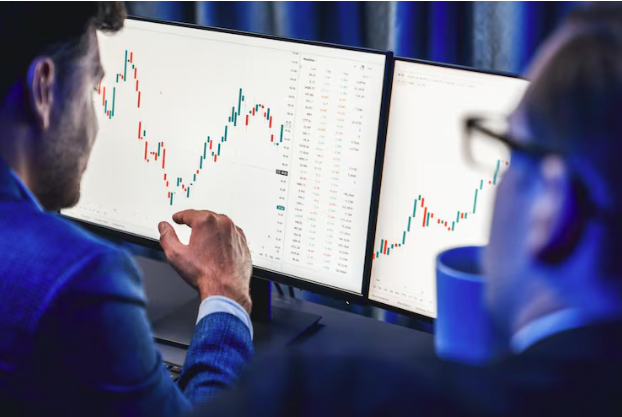
The rise of algorithmic trading has changed how share market option trading and future options are executed.
Algorithmic systems allow traders to:
- Automate trade entries and exits
- Execute multi-leg strategies instantly
- Monitor risk and exposure in real time
- Remove emotional decision-making
In the U.S., algorithmic trading now accounts for a significant portion of derivatives volume, highlighting its importance in modern market participation.
Role of Platforms Like Tradetron
Platforms such as Tradetron demonstrate how algorithmic trading concepts are becoming more accessible. Tradetron allows traders to:
- Build rule-based options strategies without coding
- Backtest futures and options strategies on historical data
- Deploy systematic trading logic through broker integrations
- Maintain discipline through automated execution
While institutional HFT remains infrastructure-heavy, platforms like Tradetron enable retail and professional traders to adopt structured, algorithm-driven approaches inspired by institutional practices.
Advantages of Algorithmic Options Trading
| Aspect | Manual Trading | Algorithmic Trading |
| Execution Speed | Limited | Instant |
| Emotional Bias | High | Minimal |
| Strategy Complexity | Restricted | Multi-leg, rule-based |
| Risk Control | Manual | Automated |
| Scalability | Low | High |
This shift is why algorithmic execution is increasingly preferred in U.S. options markets.
Conclusion
In the modern U.S. financial ecosystem, share market option trading and future options play a central role in portfolio management and speculative strategies. As markets become faster and more data-driven, algorithmic execution is no longer optional—it is essential.
Platforms like Tradetron reflect the broader shift toward automation, discipline, and scalability in derivatives trading. For traders aiming to compete in the algorithmic era, understanding futures, options, and systematic execution is a critical step forward.
Frequently Asked Questions (FAQs)
- What is share market option trading in the U.S.?
It involves trading call and put options on stocks, indices, and ETFs listed on U.S. exchanges. - How are future options different from stock options?
Future options derive their value from futures contracts, while stock options are based on individual equities. - Are futures and options suitable for retail traders?
Yes, but they require strong risk management due to leverage and volatility. - How does algorithmic trading improve options performance?
Algorithms ensure consistent execution, faster response to market conditions, and reduced emotional errors. - Can retail traders use algorithmic platforms like Tradetron in the U.S.?
Tradetron showcases how rule-based strategy automation can be applied globally, enabling traders to adopt systematic options trading methodologies.